Commercial Roofing in Phoenix and Across the Valley
Repairs, roof coatings, TPO, spray foam, modified bitumen and EPDM for warehouses, offices, retail, restaurants and multifamily buildings across the Phoenix metro. Licensed ROC #358508. Open 24 hours, 7 days. Call (602) 849-7990 for a free commercial estimate.
Commercial Roof Systems We Install and Service
- Silicone and acrylic roof coatings: Renew a dry, sound foam or membrane roof with a new reflective, waterproof surface instead of tearing it off.
- TPO single-ply membrane: White, heat-welded membrane for flat roofs with a sound deck. Reflective and clean to maintain.
- Spray polyurethane foam (SPF): Seamless foam that adds insulation and can be shaped to fix low spots, protected by a coating.
- Modified bitumen: Layered asphalt-based roofing with reinforced sheets. We repair existing mod bit roofs and install new ones.
- EPDM: Synthetic rubber membrane with bonded seams. We repair and replace EPDM roofs.
- Repairs, inspections and maintenance: Leak repairs, condition inspections with photos, and scheduled maintenance to keep drains clear and coatings intact.
Every building is priced after an estimator inspects the roof. As a guide, a recoat over sound foam typically runs about $2 to $3.75 per square foot, new spray foam about $5 to $8, and TPO about $5.50 to $9 installed. See the commercial roof cost guide or request a free estimate.
Commercial Roofing by City
Each city page covers the buildings we see there, the leak points that come with them, and the local permit rules:
Maintenance and 24/7 Emergency Repair
Scheduled roof maintenance keeps drains and scuppers clear and coatings intact before monsoon season. For an active leak, call (602) 849-7990 any time; we stop the water first, then give you a written estimate for the permanent repair. See 24/7 emergency roof repair.
Frequently Asked Questions
What types of commercial roofing systems do you install in Phoenix?
Simply Roofing installs and services all major commercial roofing systems including TPO (Thermoplastic Polyolefin), EPDM rubber roofing, modified bitumen, spray polyurethane foam (SPF), metal roofing, and elastomeric roof coatings. We help business owners choose the best system based on building size, budget, and energy-efficiency goals specific to Arizona's extreme climate.
How much does a commercial roof replacement cost in Arizona?
Commercial roof replacement costs in Arizona vary based on system type and building size. As a guide, TPO typically runs about $5.50-$9 per square foot and new SPF foam about $5-$8 per square foot. Because commercial jobs vary so much, an estimator prices each building after inspecting the roof. Simply Roofing provides free commercial estimates with transparent, itemized pricing.
Do you offer commercial roof maintenance programs?
Yes. Our commercial maintenance programs include bi-annual inspections, drainage clearing, membrane and seam inspections, minor repairs, and detailed condition reports. Regular maintenance catches small problems before they turn into emergency repairs, especially ahead of Arizona's monsoon season.
How long does a commercial roof last in Arizona's heat?
Commercial roof lifespan in Arizona depends on the system: TPO roofs last 20-30 years, EPDM 20-25 years, modified bitumen 15-20 years, and SPF foam roofs can last 30+ years with regular re-coating every 10-15 years. Arizona's extreme UV and heat accelerate aging, making proper installation and maintenance critical.
Can you repair my commercial roof without a full replacement?
In many cases, yes. Simply Roofing offers commercial roof restoration through coatings, patches, and membrane repairs that keep a dry, sound roof in service for a fraction of the cost of replacing it. We provide honest assessments and only recommend replacement when repairs are no longer cost-effective.
Do you handle emergency commercial roof repairs?
Absolutely. We provide 24/7 emergency commercial roof repair services across the Phoenix metro area. Whether it's storm damage, a sudden leak, or wind-lifted membrane, our team responds quickly to minimize business disruption and protect your inventory, equipment, and tenants. Call (602) 849-7990 for immediate help.
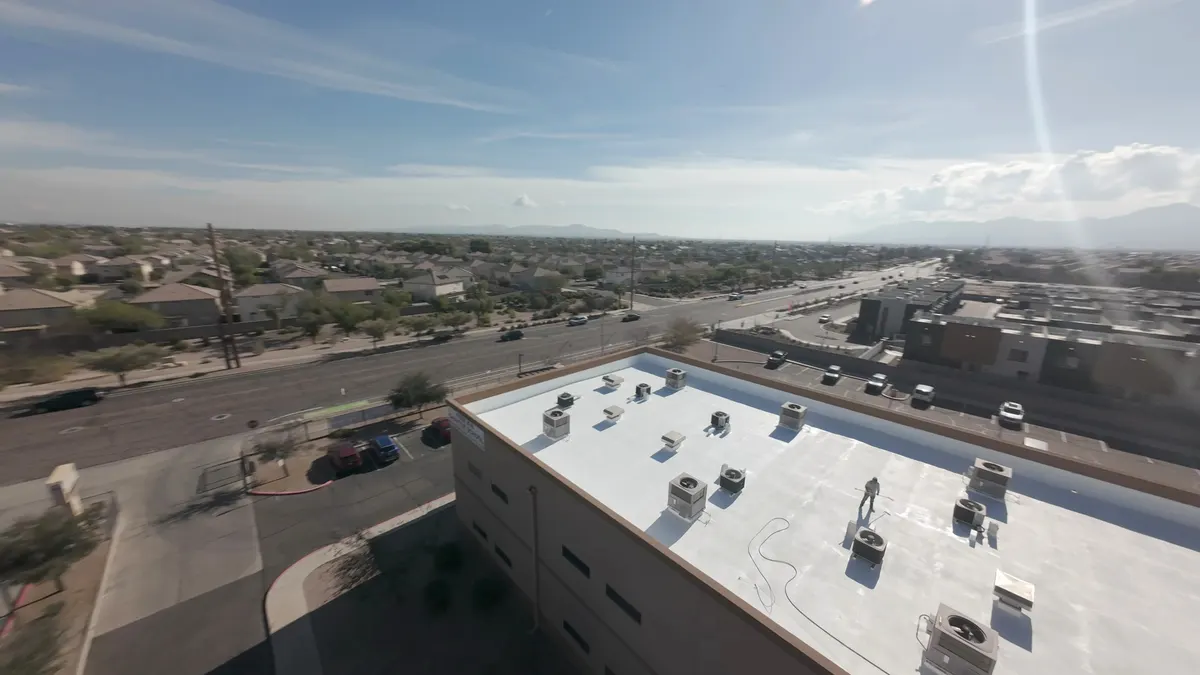
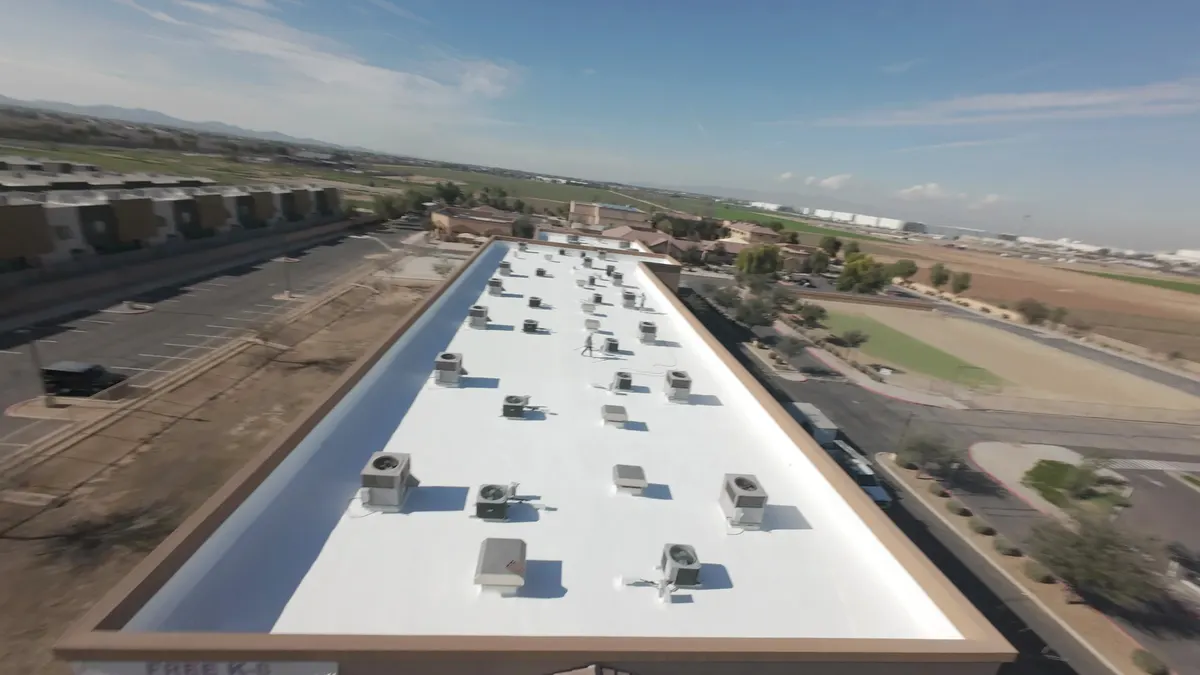
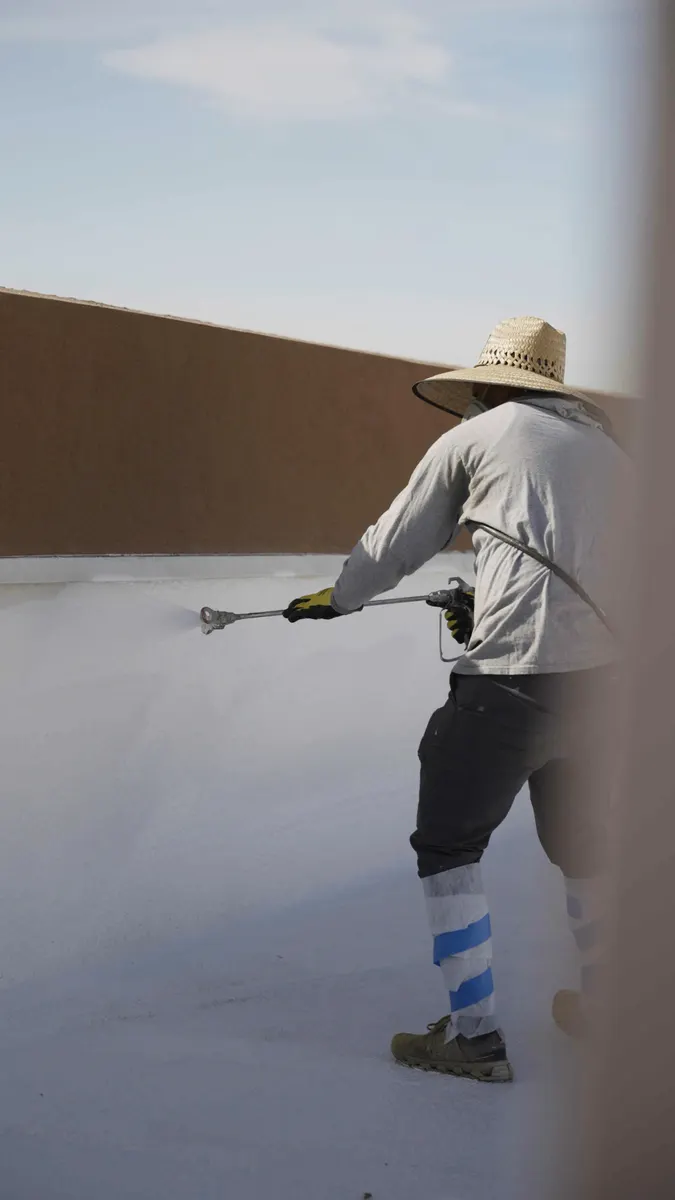
Our Commercial Crews at Work
Commercial Roofing in Arizona: Flat Roof Systems, Recoat vs. Replace, and Planning the Work
Most commercial roofs in the Valley are low-slope roofs hidden behind parapet walls, so the owner rarely sees them until something leaks. By then the problem is often a drain, a seam or a piece of rooftop equipment that has been letting water in for a while.
This guide goes past the system list above. It covers where commercial roofs fail in Phoenix heat and monsoon storms, how each system ages, how to decide between a repair, a recoat, a recover and a full tear-off, what drives cost, and what to plan for when the building has to stay open during the work.
The buildings and roofs we work on
Our commercial work covers retail strips, offices, warehouses and light industrial buildings, and multifamily buildings such as apartments, duplexes and fourplexes. Most of these have flat or low-slope roofs. Some multifamily and office buildings have pitched tile or shingle roofs, which we handle the same way we handle home roofs.
A typical low-slope commercial roof has more going on than a house roof. These are the parts we look at on every visit:
- The field of the roof: foam, coating, single-ply membrane or modified bitumen
- Parapet walls, their caps or coping, and the flashing where the roof turns up the wall
- Scuppers, interior drains, gutters and downspouts
- Curbs under HVAC units, evaporative coolers and exhaust fans
- Pipe, conduit and gas-line penetrations, and the supports that hold them
- Skylights, roof hatches and smoke vents
- Solar racking and its attachments
- Paths that service techs walk to reach equipment
Why commercial roofs fail in the Phoenix area
Sun and heat wear down the top surface first. A foam roof depends on its coating to block UV. Once the coating thins, the foam underneath starts to break down. Single-ply membranes and modified bitumen also age faster on a roof that never gets shade, and seams and flashings take the most stress as the roof expands in the day and shrinks at night.
Standing water is the next big cause. Roofing standards treat water still sitting 48 hours after rain as ponding. A roof that holds water longer than that usually has a low spot, a sagging deck or a blocked drain. Ponding speeds up coating and membrane wear, adds weight, and gives a small defect time to leak.
Drains and scuppers clog. Monsoon storms, which run June 15 to September 30, push dust, leaves, palm fronds and trash onto flat roofs, often right into the drain. One clogged scupper behind a parapet can back water up over flashing that was never meant to sit underwater.
Rooftop equipment causes more leaks than most owners expect. HVAC and cooler curbs, condensate lines, gas lines and conduit all pass through the roof. Every service call puts a tech on the roof with tools and ladders. Dropped panels, cut membrane and loose screws are common, and many of them aren't reported.
Parapets are a weak point on older buildings. Water gets in through cracked stucco, loose coping or open joints on top of the wall, runs down inside it, and shows up as a leak that looks like it came from the roof.
Finally, many older Valley commercial roofs have been patched and recoated several times by different contractors. Layers of mismatched materials can trap water, and they affect whether the roof can be recoated or recovered again.
How each system ages, and what fixing it looks like
Spray foam (SPF): the foam itself can last a long time if its coating is kept up. How often it needs a recoat depends on the coating type and how thick it was applied. When we repair foam, we cut out any section that is wet or crushed, fill it with new foam, and coat it. A recoat on dry foam starts with cleaning, fixing blisters and soft spots, and priming where the coating maker calls for it.
Roof coatings over other roofs: acrylic, silicone and other elastomeric coatings can extend the life of a roof that is dry and sound. A coating is not a fix for wet insulation or bad drainage. Coating over those problems seals the water in.
Single-ply membranes (TPO, PVC and EPDM): these come in large sheets with seams that are heat-welded or bonded with adhesive or tape, depending on the product. Most repairs are at seams, at corners and around penetrations, or are punctures from foot traffic. Repairs are patched with compatible membrane, following the manufacturer's details so the warranty isn't affected.
Modified bitumen and built-up roofs: these are layered systems. As they age, they show cracks in the surface, blisters, and laps that start to open. Small areas can be cut out and patched. Widespread blistering or open laps usually mean the roof is near the end of its life.
Metal roofs: leaks usually start at fasteners, panel laps, ridge and trim pieces, or where equipment curbs pass through the panels. Repairs involve replacing fasteners, resealing laps and re-flashing curbs. Metal roofs can also be coated once rust and loose fasteners are dealt with.
Pitched tile and shingle roofs on apartments and offices: these fail like home roofs do. On tile, underlayment is usually what wears out first, often after 15 to 25 years. For replacements we tear off to the deck, replace damaged deck boards, and install high-temperature synthetic or self-adhered underlayment, with cool-rated shingles on shingle roofs.
Repair, recoat, recover or replace
Low-slope roofs give owners more choices than home roofs do. Which one makes sense depends on whether the roof is dry underneath, how many layers are already up there, and how much life the building needs from it.
- Repair: fixes a specific leak, seam, curb or drain. It makes sense when the rest of the roof is in good shape.
- Recoat: puts a new coating over a dry, sound foam or coated roof. It renews the UV protection and keeps the existing roof in place.
- Recover: installs a new roof system over the existing one. The building code doesn't allow this over a roof that is water-soaked or too worn to support new roofing, or over a roof that already has two or more layers. Coatings over a foam roof are a limited exception.
- Replace: tears off to the deck, replaces damaged decking, corrects drainage, and installs a new system. This is the right call when insulation is wet in many spots, the deck is damaged, or the roof has used up its recover options.
How we check what's under the surface
Choosing between those options depends on what is under the top layer. We walk the whole roof, probe soft areas, and, when needed, take small core cuts to count layers and see whether the foam or insulation is wet. Core cuts are patched before we leave. On the inside, we look at stains on ceiling tiles and the underside of the deck where it can be seen.
We photograph what we find so you can see which parts of the roof are sound and which aren't. If both a recoat and a replacement are reasonable choices, we price both and explain what each one buys you.
What drives the cost of commercial roofing
Commercial roofs vary too much in size, system and condition for a reliable price without seeing the roof. An estimator inspects it and gives you a written price for the scope you choose. These are the main factors that move that price:
- Roof area, and how many separate roof levels or sections there are
- Repair, recoat, recover or full tear-off, and how many old layers have to come off
- How much wet foam, wet insulation or damaged deck has to be replaced
- Drainage fixes such as tapered insulation, crickets or new drains and scuppers
- The number of curbs, penetrations and parapet walls that need new flashing
- Access: building height, where a crane or hoist can be set up, and whether the work has to happen around business hours
- Rooftop equipment that has to be lifted or disconnected, including solar arrays that need to be detached and reset
- The manufacturer warranty you want, since some warranties require specific materials, thicknesses and inspections
Taxes, budgeting and financing
Under federal tax law, improvements to the roof of a nonresidential building can qualify for Section 179 expensing, which means the cost may be deducted in the year the roof is placed in service instead of being depreciated over many years. Whether it applies to your building, and whether a repair should be treated as an expense or as a capital improvement, is a question for your tax adviser. Ask us for a written breakdown of the scope if your adviser needs one.
Financing is available for qualifying projects. An estimator can go over the options when you get your price.
The photos from an inspection also help with longer-term planning. Many owners use them to schedule a recoat or replacement a year or two out instead of waiting for an emergency.
Working on a building that stays open
Most commercial roofs get replaced while tenants and customers are inside. Before work starts, these are the things to settle with us:
- Work hours, especially for noisy tear-off or work over occupied suites
- Where materials, the dumpster and any lift equipment will go, and what parking or entrances will be blocked
- Odor and fumes from coatings and adhesives, and whether rooftop air intakes need to be shut off or covered for a time
- Who disconnects and reconnects HVAC units, gas lines and solar equipment
- How each day's work area is sealed before the crew leaves, especially during monsoon season
- Who the property manager, tenants and HOA or owners' association should call with questions
Inspections and maintenance between projects
Many commercial leaks start as problems that someone walking the roof could have spotted. Two good times to check a Valley roof are in late spring, before monsoon season starts, and in the fall, after it ends. A useful inspection covers:
- Clearing debris from roof drains and scuppers, and checking that strainers are in place
- Looking for ponding, and for spots where water sat after the last rain
- Checking coating thickness and wear on foam and coated roofs
- Checking seams and laps on membranes and modified bitumen
- Flashing at every curb, pipe and parapet wall
- Parapet caps, coping and stucco for cracks or open joints
- Damage left behind by HVAC or other service contractors
- Photos and a short written summary for your records
Storm damage and insurance
After a monsoon storm, the first step is protecting the building and its contents. We cover open areas temporarily and come back for the permanent repair once the roof is dry.
If you're filing an insurance claim, we photograph and document the damage and can meet your insurance company's adjuster on the roof to show what we found. The insurer decides what is covered and how much it pays. Arizona law requires a licensed adjuster to negotiate a claim on an owner's behalf, so we don't negotiate your settlement. If you want someone representing you, you can hire a licensed public adjuster or an attorney.
Permits, codes and associations
Permit rules for roofing differ from city to city in the Valley. Many cities don't require a permit to replace a roof with the same material or for ordinary repairs, but some do, some require one as soon as deck boards or framing are replaced, and a few treat almost all construction as permitted work. Changing to a heavier roof system usually needs a permit and a check that the structure can carry the weight. Our city guides explain each city's rule, and where the rule is unclear for a commercial project, we confirm it with the city before work starts.
Commercial centers and condo or townhome communities often have an owners' association or a landlord with rules about roof color, rooftop equipment and contractor insurance. We can provide product details when an association or property manager asks for them.
You can check any contractor's license on the Arizona Registrar of Contractors website. Commercial roofing requires a commercial or dual roofing license class. A residential-only roofing license doesn't cover it.
Where we work
We serve commercial and multifamily buildings across the Phoenix area from our offices in Ahwatukee and Mesa, including Phoenix, Mesa, Tempe, Chandler, Gilbert, Scottsdale, Glendale, Peoria, Goodyear and the surrounding cities. Our city guides cover local permit rules and the roofs we see most often in each one.
Where We Work
- Phoenix
- Mesa
- Chandler
- Scottsdale
- Gilbert
- Tempe
- Glendale
- Peoria
- Surprise
- Goodyear
- Avondale
- Buckeye
- Queen Creek
- Maricopa
- Fountain Hills
- Paradise Valley
- Cave Creek
- Carefree
- Litchfield Park
- Tolleson
- El Mirage
- Wickenburg
- Youngtown
- Guadalupe
- Sun City
- Sun City West
- Sun Lakes
- Gold Canyon
- Apache Junction
- Anthem
- New River
- Rio Verde
- Ahwatukee
- Fort McDowell
Guides and cost breakdowns
- Commercial Roof Cost in Arizona (2026 Pricing Guide) (Cost guide)
- Flat Roof Drainage in Arizona: Parapets, Scuppers, Ponding and Monsoon Leaks (Guide)
- Roof Coatings in Arizona: Silicone vs Acrylic, When Coating Works and When It Doesn't (Guide)
- Commercial Roofing Systems Explained: TPO, Foam, EPDM, Modified Bitumen and More (Guide)
- Cool Roofs in Phoenix: How Reflective Roofing Works and When It Pays (Guide)
- Foam vs TPO Roofing for Commercial Buildings in Arizona (Comparison)